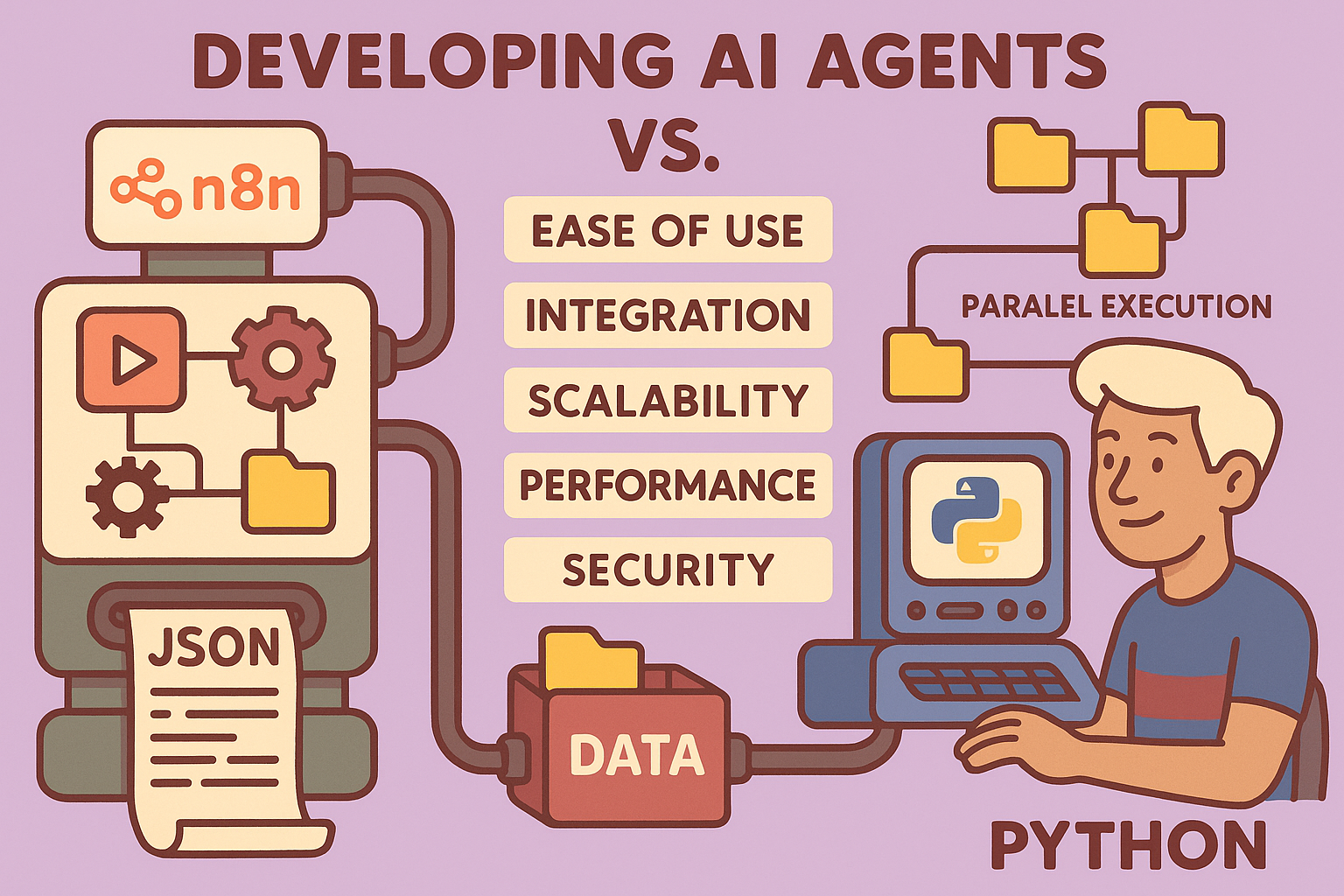
The question of whether to develop AI agents with N8N or Python is a frequent one, symbolizing the broader debate between no-code and code-based development. This article aims to provide a clear framework for making this decision, weighing the pros and cons of each approach and suggesting a hybrid strategy for optimal results.
General Recommendation
To summarize, N8N is generally recommended for complex internal tool integrations, proofs of concept, and team collaboration across varying skill levels due to its ease of use and extensive integration capabilities. Python, on the other hand, is the preferred choice for production-scale applications or any project demanding high speed, granular control, and ultimate flexibility. Many developers start with N8N for rapid prototyping and then transition to Python for scaling and advanced customization.
Let’s delve into the specifics of each approach.
N8N: The No-Code/Low-Code Powerhouse
N8N stands out for its visual, node-based interface, making it incredibly accessible for building AI agents and automations.
Advantages of N8N
-
Ease of Getting Started and Visual Development: N8N offers a shallow learning curve. Its visual workflow builder provides a canvas-like experience, allowing users to easily connect different nodes and visualize their agent’s logic. This contrasts sharply with the abstract nature of code.
-
Extensive Integrations and Templates: N8N boasts hundreds of pre-built integrations with various services (e.g., PostgreSQL, Google Drive) and thousands of templates. This significantly reduces the time and effort required to set up new services, as it simplifies authentication and configuration. This is a considerable advantage over code-based solutions, which often require developers to build integrations from scratch.
-
Scalability with Queue Mode: Despite being a node-based platform, N8N offers excellent scalability through its “Queue Mode” feature. While more advanced, this enables N8N to handle a substantial number of users and tasks effectively.
-
Open-Source and Self-Hostable: N8N’s open-source nature allows for self-hosting, making it ideal for projects involving sensitive data or requiring a highly secure, local environment. This is a significant benefit for privacy-conscious applications.
Disadvantages of N8N
-
Licensing for Commercial Use: While open-source and self-hostable, commercializing N8N workflows typically requires a license fee. This is a crucial consideration for businesses looking to deploy N8N-based products publicly.
- Performance and Integration Limitations:
- Performance Overhead: Node-based platforms like N8N generally incur a performance overhead compared to direct code execution. Even with Python, often considered slower than other languages, its efficiency outpaces N8N.
- Integration Box: Users are limited to the integrations N8N provides. While extensive, there will inevitably be instances where a specific tool is not integrated, requiring manual integration via HTTP request nodes, which can be complex and less efficient than direct coding.
- Incomplete Integration Capabilities: Even existing integrations may not always meet specific needs. For example, Google Drive integration might monitor file creation but not deletion, creating challenges for synchronization tasks like RAG agent knowledge bases.
-
Inefficient Code Nodes: N8N allows injecting code (JavaScript or Python) into workflows for customization. However, these code nodes are not highly efficient, and security restrictions limit the libraries that can be imported. This often leads to workflows where a significant portion is custom code, begging the question of why not just code the entire solution.
-
Difficult Version Control: N8N workflows, when saved as JSON, are challenging to version control using tools like Git. The JSON diffs are often unreadable, making it difficult to track changes over time or revert to previous versions effectively.
- Poor Handling of Large Files: N8N struggles with large files, especially for RAG AI agents. Users report issues with PDF files as small as 20 MB, whereas Python can handle gigabytes of data if the machine has sufficient memory.
Python: The Code-Centric Powerhouse
Python, representing code-based development, offers unparalleled control and flexibility but comes with its own set of challenges.
Disadvantages of Python
-
Steeper Learning Curve: Developing with Python requires a foundational understanding of programming concepts. Even with AI-powered coding assistance, validating and understanding the generated code is essential, demanding a higher initial effort.
-
Increased Security Risks: While N8N abstracts many security concerns (like credential management), Python users must be more knowledgeable about security best practices, as they are responsible for implementing and managing these aspects.
-
Manual Integration Setup: Unlike N8N’s pre-built nodes, integrating various services with Python often involves building connections from scratch, even if similar integrations exist. This can be time-consuming compared to N8N’s drag-and-drop functionality.
-
Challenging Visualization: Code-based workflows are generally harder to visualize than N8N’s graphical interface. While tools like Langgraph Studio and Langfuse offer some visualization and tracing capabilities, they rarely match the intuitive visual clarity of no-code platforms.
Advantages of Python
-
Complete Control and Customization: Python offers virtually limitless possibilities. Unlike no-code tools, which hit limitations, Python allows developers to implement any logic, feature, or integration precisely as needed.
-
Parallel Execution and Token Streaming: Python enables true parallel execution of tasks, a crucial feature for complex AI agents (e.g., multi-agent research systems). This enhances both speed and efficiency. Additionally, features like token streaming, which improves user experience, are readily achievable in Python but not in N8N.
-
Superior Performance: Python generally offers better raw performance than N8N due to direct code execution, which is vital for demanding applications.
-
Access to Best Open-Source AI Tools and Libraries: Python provides direct access to the latest and most powerful open-source AI tools and libraries (e.g., Langraph for knowledge graphs, LlamaIndex for RAG). While some integrations might be available in N8N, Python offers a seamless and comprehensive ecosystem for AI development.
-
Leveraging AI-Powered Coding Assistance: AI coding assistants (like Codeium and Claude Code) significantly accelerate development in Python, bridging the gap with N8N’s rapid prototyping capabilities. These tools help generate, debug, and optimize code quickly.
-
Better Scalability: Python projects inherently scale better, especially for production environments, without the licensing concerns associated with commercial N8N deployments.
-
Robust Version Control with Git: Python code integrates seamlessly with Git, enabling detailed version control, collaborative development, easy rollback capabilities, and efficient management of different environments.
The Hybrid Approach: Best of Both Worlds
The most effective strategy often involves a hybrid approach, leveraging the strengths of both N8N and Python.
How to Implement a Hybrid Approach:
- N8N for Orchestration and Integrations: Use N8N for managing application entry points, handling various integrations, and orchestrating high-level workflows. Its visual interface and extensive connectors make it ideal for rapidly setting up and supervising complex processes.
- Python for Heavy Computing and Microservices: Offload computationally intensive tasks—such as data chunking for RAG agents, processing large datasets, or managing complex AI models—to external Python microservices. These services can be called from N8N workflows, effectively combining N8N’s orchestration prowess with Python’s performance and flexibility.
- Co-deployment: Python and N8N can be deployed together on the same cloud instance, allowing them to communicate seamlessly and operate as a cohesive system. This approach maximizes efficiency and flexibility by utilizing each tool for its strongest capabilities.
This hybrid model allows developers to benefit from N8N’s ease of use and rapid prototyping while harnessing Python’s power for performance-critical and highly customized tasks.
Conclusion
The choice between N8N and Python for AI agent development is not always mutually exclusive. While N8N excels in rapid prototyping, visual orchestration, and ease of integration for internal tools, Python offers unparalleled control, performance, and scalability for production-grade applications. By understanding the distinct advantages and disadvantages of each and considering a hybrid approach, you can make an informed decision that best suits your project’s specific requirements.
🔍 Discover Kaptan Data Solutions — your partner for medical-physics data science & QA!
We're a French startup dedicated to building innovative web applications for medical physics, and quality assurance (QA).
Our mission: provide hospitals, cancer centers and dosimetry labs with powerful, intuitive and compliant tools that streamline beam-data acquisition, analysis and reporting.
🌐 Explore all our medical-physics services and tech updates
💻 Test our ready-to-use QA dashboards online
Our expertise covers:
🔬 Patient-specific dosimetry and image QA (EPID, portal dosimetry)
📈 Statistical Process Control (SPC) & anomaly detection for beam data
🤖 Automated QA workflows with n8n + AI agents (predictive maintenance)
📑 DICOM-RT / HL7 compliant reporting and audit trails
Leveraging advanced Python analytics and n8n orchestration, we help physicists automate routine QA, detect drifts early and generate regulatory-ready PDFs in one click.
Ready to boost treatment quality and uptime? Let’s discuss your linac challenges and design a tailor-made solution!
Get in touch to discuss your specific requirements and discover how our tailor-made solutions can help you unlock the value of your data, make informed decisions, and boost operational performance!
Comments