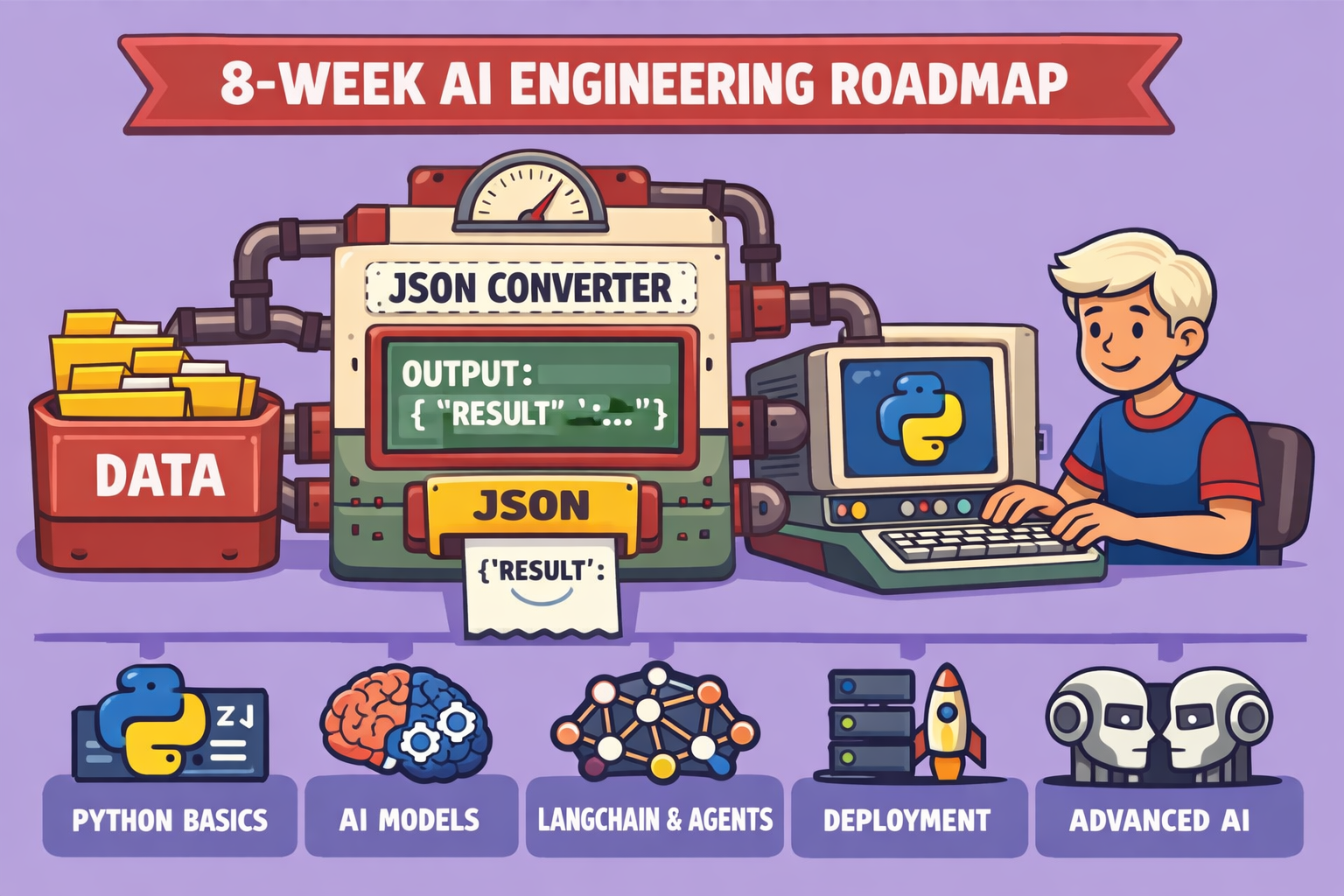
The landscape of technology is rapidly evolving, with Artificial Intelligence at its forefront. For many seasoned software engineers, the aspiration to transition into AI engineering is not just about keeping up with trends but about embracing the future of development. This comprehensive 8-week roadmap is designed specifically for software engineers with a minimum of two years of experience, aiming to equip them with the essential skills to thrive as an AI engineer. It recognizes that AI engineering is fundamentally software engineering complemented by deep understanding of large language models (LLMs), AI systems design, and robust backend capabilities.
This fast-paced program, requiring approximately 4-5 hours of study five to six days a week, combines technical mastery with crucial soft skills, emphasizing practical, industry-relevant knowledge.
The 8-Week AI Engineering Transition Roadmap
Week 1: AI and Python Fundamentals
The journey begins with solidifying Python fundamentals, the bedrock of AI. As an experienced software engineer, your existing knowledge of programming concepts from other languages (like Java or .NET) can be leveraged through “transfer learning” to quickly grasp Python’s syntax, data types, functions, loops, control flow, and object-oriented programming. The focus here is on efficiently mapping your existing knowledge to Python rather than an in-depth, time-consuming dive.
Key Learning Areas:
- Python Essentials: Reinforce Python basics (syntax, data types, control structures, functions, OOP).
- Backend Development with FastAPI: Learn to build efficient backends using FastAPI, applying your prior backend experience.
- LLM API Interaction with Grok: Utilize free tools like Grok to experiment with LLM APIs, understanding how to integrate them into Python applications without incurring costs during the learning phase.
- AI-First Engineering and Prompt Engineering: Master the principles of “web coding” for AI, including effective context supply, token optimization, and using AI coding assistants like Claude Code and ChatGPT to accelerate development.
- Generative AI Basics: Understand core concepts such as Generative AI (GenAI), Agentic AI, embeddings, vector databases (starting with open-source options like ChromaDB, but also commercial ones like Qdrant and Pinecone), and their practical applications.
Soft Skills Focus:
- Leveraging AI as a Personal Tutor: Use AI tools like Claude Code or ChatGPT to clarify concepts and accelerate learning.
- Personal Branding Foundation: Begin building a professional online presence on platforms like LinkedIn and X (formerly Twitter) to stream your credibility and engage with the tech community.
Assignments:
- Build a simple FastAPI server.
- Develop a basic search engine using a vector database (ChromaDB or similar).
- Create a professional LinkedIn and X profile.
Week 2: Retrieval Augmented Generation (RAG) and LangChain
Most real-world AI projects, especially those dealing with internal organizational data, rely heavily on RAG. This week delves into the theory and practical implementation of RAG pipelines.
Key Learning Areas:
- RAG Fundamentals: Understand what RAG is, its architecture, and how to build efficient RAG pipelines.
- Document Processing: Learn document parsing and chunking techniques using libraries like Docling.
- LangChain Basics: Explore LangChain for developing chatbot models and other AI applications that interact with various data sources.
Soft Skills Focus:
- Community Engagement: Actively follow prominent AI personalities and engage meaningfully with their posts on LinkedIn and X. This builds micro-relationships and enhances visibility within the AI community.
- Business Fundamentals: Start consuming resources that provide business knowledge, especially in your target domain (e.g., finance, healthcare), to develop a “product engineer” mindset.
Assignments:
- Code a RAG pipeline from scratch in Python to understand the underlying mechanics (with Claude Code assistance).
- Build a simple LangChain RAG chatbot for a specific sector (e.g., healthcare or finance).
- Write meaningful comments on at least 10 AI-related posts.
- Analyze three business case studies to extract key learnings.
Week 3: Agentic AI Fundamentals
Moving beyond simple RAG, this week explores the concept of AI agents, which are crucial for complex, multi-step tasks.
Key Learning Areas:
- AI Agents Concepts: Grasp what AI agents are, their architecture (e.g., ReAct loop: reasoning + action), and how they function.
- Building Agents with LangChain: Practical application of LangChain for creating AI agents, including routing mechanisms based on intent and task complexity.
- AI Agent Security and Guardrails: Understand critical aspects of securing AI systems, handling sensitive data, and implementing guardrails against undesirable outputs.
- Evaluation Techniques for AI Systems: Learn how to evaluate probabilistic AI systems effectively, which differs significantly from traditional software testing.
Soft Skills Focus:
- Effective Presentation Skills: Learn to create compelling and engaging presentations (referencing “Death by PowerPoint” principles) to communicate complex AI concepts to diverse audiences, including non-technical stakeholders.
- Educating Business Stakeholders: Develop strategies to effectively communicate with business clients who might have partial or evolving technical understanding.
Assignments:
- Develop a basic AI agent capable of routing queries or tasks.
- Write two meaningful blog posts or articles on an AI tech topic requiring clear explanation.
Week 4: AI Application Observability and Deployment
This week focuses on bringing AI applications to life in production environments, emphasizing monitoring and deployment strategies.
Key Learning Areas:
- Langsmith: Explore Langsmith for observability and monitoring of LangChain applications, including tracking executions, traces, and runs.
- AI System Deployment: Understand the nuances of deploying probabilistic AI systems to production, which necessitates different approaches compared to deterministic software.
- AWS Agent Code: Learn about platforms like AWS Agent Code for deploying AI agents in cloud environments.
Soft Skills Focus:
- Open-Source Contributions: Start contributing to open-source projects. Identify “good first issues” in popular repositories (e.g., Hugging Face Transformers) to build practical experience and online credibility.
Assignments:
- Implement Langsmith for an existing AI application.
- Deploy a simple AI agent (e.g., the one built in Week 3) to a cloud platform like AWS using AWS Agent Code.
- Make at least one meaningful contribution to an open-source AI project.
Week 5: Multi-Agent Systems and Context Engineering
Building on the concept of individual agents, this week introduces the architecture and implementation of cooperative multi-agent systems.
Key Learning Areas:
- Multi-Agent Systems: Understand the principles behind designing and building systems where multiple AI agents collaborate to solve complex problems.
- LangGraph for Custom Agents: Utilize LangGraph to achieve deep control and customization over agentic systems, particularly multi-agent setups.
- Crui AI: Explore other frameworks for multi-agent development.
- Advanced Context Engineering: Deepen your understanding of providing optimal context to LLMs for improved performance and relevance.
Assignments:
- Build a multi-agent system to automate a simple marketing task.
- Develop an API for a public service using multi-agent principles.
Week 6: Advanced AI Engineering Topics
This week dives into crucial aspects of optimizing AI applications for cost, performance, and specific use cases.
Key Learning Areas:
- Cost Optimization: Learn techniques like rate limiting, model selection (cascading models), and response caching to manage LLM API costs effectively.
- Multi-Modal RAG: Explore the application of RAG to multi-modal data (images, audio, video), especially relevant in fields like healthcare and manufacturing.
- LLM Fine-tuning (LoRA, QLoRA with Unsloth): Understand when and how to fine-tune LLMs for specific tasks using techniques like LoRA and QLoRA, leveraging frameworks like Unsloth.
- Running Models Locally: Learn to deploy and run LLMs locally using frameworks like Ollama, catering to privacy-sensitive requirements where data cannot leave the premises.
Assignments:
- Implement cost optimization strategies (caching, rate limiting) in an existing AI application.
- Experiment with multi-modal RAG on a small dataset.
- Attempt a basic LLM fine-tuning task using Unsloth if hardware permits.
Week 7: Declarative AI with DSPy
This week introduces a different paradigm for building AI applications: declarative programming.
Key Learning Areas:
- Declarative AI Concepts: Understand the declarative approach to AI development, contrasting it with traditional imperative methods.
- DSPy Framework: Learn to use DSPy, a framework specifically designed for building AI applications declaratively, leveraging your software engineering background in declarative programming.
Assignments:
- Rebuild a previous AI agent or application using the DSPy framework.
- Explore and document the advantages and disadvantages of declarative AI for your use cases.
Week 8: Cloud Deployment and Real-World Considerations
The final week focuses on robust deployment strategies and architectural considerations for AI systems in leading cloud environments.
Key Learning Areas:
- Cloud Platforms for AI: Gain expertise in deploying AI models on major cloud platforms like Azure and AWS (and optionally Google Cloud Platform), understanding their AI-specific services.
- Cloud Fundamentals: Reinforce understanding of core cloud concepts such as resource groups, subscriptions, regions, storage, and Identity and Access Management (IAM), applying transfer learning from one cloud platform to another.
Learning Tip: Focus on mastering one cloud platform thoroughly (e.g., Azure) before exploring others.
Assignments:
- Deploy a complex multi-agent system to a cloud platform (Azure or AWS).
- Optimize the deployed application for cost and performance.
- Reflect on your 8-week journey, outlining key learnings and future development plans.
This roadmap emphasizes a blend of focused technical learning, practical assignment-based application, and continuous development of crucial soft skills. By the end of these eight weeks, software engineers should be well-equipped to undertake AI engineering roles, contribute to AI-driven projects, and navigate the exciting future of artificial intelligence.
Remember, effective learning is about digesting and implementing, not just consuming information. Forming study groups can provide accountability, diverse perspectives, and a supportive learning environment.
🔍 Discover Kaptan Data Solutions — your partner for medical-physics data science & QA!
We're a French startup dedicated to building innovative web applications for medical physics, and quality assurance (QA).
Our mission: provide hospitals, cancer centers and dosimetry labs with powerful, intuitive and compliant tools that streamline beam-data acquisition, analysis and reporting.
🌐 Explore all our medical-physics services and tech updates
💻 Test our ready-to-use QA dashboards online
Our expertise covers:
🔬 Patient-specific dosimetry and image QA (EPID, portal dosimetry)
📈 Statistical Process Control (SPC) & anomaly detection for beam data
🤖 Automated QA workflows with n8n + AI agents (predictive maintenance)
📑 DICOM-RT / HL7 compliant reporting and audit trails
Leveraging advanced Python analytics and n8n orchestration, we help physicists automate routine QA, detect drifts early and generate regulatory-ready PDFs in one click.
Ready to boost treatment quality and uptime? Let’s discuss your linac challenges and design a tailor-made solution!
Get in touch to discuss your specific requirements and discover how our tailor-made solutions can help you unlock the value of your data, make informed decisions, and boost operational performance!
Comments